|
Link
|
Summary
|
|
|

2013 - present
Circuit Stickers
|
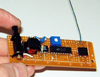
Circuit stickers are peel-and-stick electronics for crafting circuits. |
Craft
technology for artistic expression
|
|
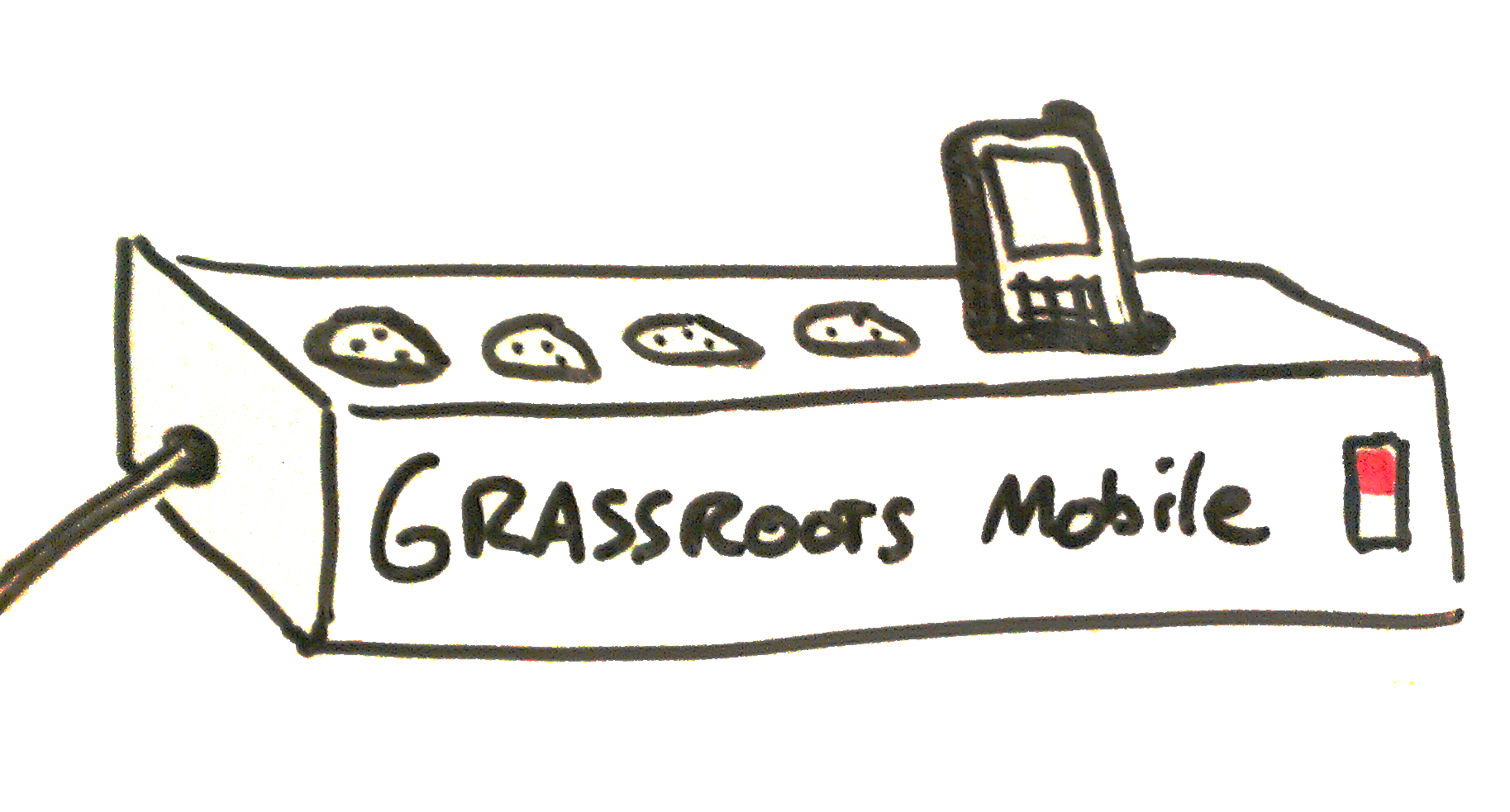
2012 - present
GrassRootsMobile
|
A GSM payments enabled powerstrip to enable sharing of electricity via informal connections. |
Energy Management
|
|
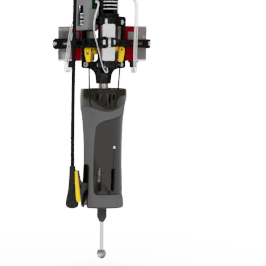
2011 - present
The FreeD
|
A handheld digital milling device for craft and fabrication
|
Ubiquitous Computing
Human-Computer Interaction
Digital Fabrication
Craft
|
|
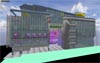
2010 - present
DoppelLab
|
Using a game engine to browse and interact with data from densely-deployed sensor/actuator networks
|
Sensor Networks
Dynamic Visualization
Cross-Reality
|
|
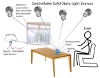
2010 - present
Adaptive Lighting
|
We
have constructed a variety of lighting networks to optimize the
electrical and photometric properties of solid-state lighting
while meeting the illumination levels set by the
user.
|
Sensor Networks
Energy Management
Control & Optimization
|
|
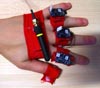
2010
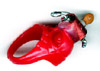
RingTags
|
Passive Ring-like gestural finger controller for a wearable computer system..
|
Passive Sensing
Wearable Computing
HCI
|
|
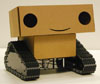
2009 - 2010
Interactive Story Capture Camera
|
A robotic camera programmed with
an interactive scenario designed to pull stories from people, captured as structured media streams.
|
Human-Robot Interaction
Social Computing
Interactive Media
|
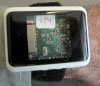
2008 - 2009
Personalized Building Comfort Control
|
A novel air-conditioning control system, focused around the individual, with body worn sensors determining comfort in real-time. Multi-modal actuation and sensing allows the building to respond to the user wherever he or she is located. Issues of arbitration between users and comfort/cost tradeoffs are addressed. |
Sensor Networks
Building Energy Systems
Low-Power Circuit Design
Reinforcement Learning
|
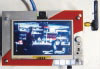
2008 - 2010
Ubiquitous Sensor
Portals
|
A
multimodal sensor/actuator network installed throughout the
Media Lab to support a variety of projects. |
Sensor Networks
Ubiquitous Computing
Pervasive Dynamic Media
X Reality
|
|
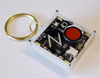
2008 - 2010
NONO Badge
|
We
are constructing a configurable infrastructure to protect
users' dynamic levels of privacy in a pervasive sensor network.
The work is based around a configurable privacy badge that can
alert the user to the presence of participating sensor
networks, plus emit an RF beacon with which the network can
gauge the level of privacy desired.
|
Sensor Networks
Ubiquitous Computing
Privacy
|
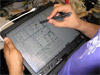
2007 - 2008
Ubicorder
|
The Ubicorder is a mobile, location and orientation
aware device that enables users to browse and interact with
real-time data from sensor networks.
|
Sensor Networks
Ubiquitous Computing
Mobile Devices
|
2008
ChainMail
|
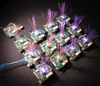
An
ultradense multimodal sensor network as an electronic sensate
"skin". |
Sensor Networks
Electronic Skin
Tactile sing
|
2006 - present
sportSemble
|
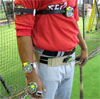
A
high speed wearable wireless sensor network that enables direct
measurement and analysis of the extreme forces that an
athlete's body experiences during activity. These measurements
allow sports medicine doctors to understand, treat and prevent
sports injuries. |
Sensor Networks
Biomechanics
Sports Medicine
|

2006 - 2010
Spinner
|
Application of a lab-wide sensor network platform
designed to detect and capture fragmented events of human
behavior that can be collected and sequenced into a cohesive
narrative that conveys a larger overall meaning. This project
also looks at the development of parametric models of narrative
that can be mapped on to sensor-detectable elements of human
activity. |
Human-Centric Sensing
Video Networks
Phenomenology
Experiential Design
Narratology
|
2007 - 2008
PuDAC
|
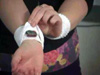
Interactive music running on a Nokia 800 (phone-like
PDA) exploiting a Pure Data Compiler (PuDAC) and wireless
wearable sensors for mobile interactive music and
exercise-generated media - a glimpse at the future of the
portable music player. |
Sensor Networks
Interactive Music
Mobile Devices
|

2006 - 2008
CargoNet
|
Micropower sensate tags for supply-chain management
and security applications. These wireless sensor nodes are
low-cost devices that monitor many modalities relevant to
shipping and supply-chain needs. They keep extremely low
standby current, asychronously waking up to exceptional
phenomena with dynamically adjustable thresholds. |
Sensor Networks
Power Management
|
2006 - 2010
Tricorder
|
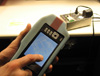
Star
Trek style Tricorder that lets you 'See through the walls' by
using multi hop sensor networks. An Augmented Reality platform
for sensor networks. |
Sensor Networks
Augmented Reality
|
2006 - 2010
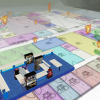
Dual Reality
Lab
|
Virtual and real worlds that reflect, influence, and
merge into each other by means of deeply embedded
sensor/actuator networks.
|
Sensor Networks
X Reality
|
2005 - 2008
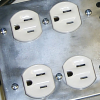
Plug
|
A
power strip imbued with sensing, computational, and
communication capabilities in order to form the backbone of a
sensor network in domestic and occupational environments.
|
Sensor Networks
Ubiquitous Computing
|
2005 - 2007
uTags
|
Development of a low-cost system to track the precise
(cm-scale) 3-D position of large numbers of objects tagged with
passive SAW microwave RF transponders at short-range (3-100m)
and in real time.
|
Ubiquitous Computing
Mobile Sensor Networks
Localization
|

2005 - 2008
Groggy
Wakeup
|
An
automated framework for generating a population of classifiers
for power-efficient detection in wearable sensors.
|
Power Management
Adaptive Systems
Wearable Computing
|
2003 - 2004
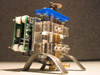
Parasitic Mobility
|
Research into devices that can use the actuation and
navigational intelligence of hosts present in the
environment.
|
Power Harvesting
Mobile Sensor Networks
Robotics
|
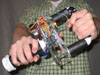
2003-2004
FlexiGesture
|
A
sensor-rich adaptive gesture and affordance learning platform
for electronic music control.
|
Adaptive interfaces
Multi-DOF sensing
Electronic music control
|
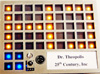
2003-2007
The UberBadge
|
A
versatile wearable computer platform in the form of a badge,
featuring three processors, RF and IR communication, built in
microphone, audio output, large LED display and LCD capability,
pager vibrator, large flash memory capacity, and extensive
expansion possibilities. Designed to enable a wide variety of
applications where mobile and social computing intersect.
|
Wireless Sensor Clusters
Wearable Systems
|
|
|
A
compact RF transceiver card, originally developed for the
UberBadge project, but useful for many different
applications.
|
Wireless Sensor Clusters
Wearable Systems
|
|
|
In association with TTT sponsor Schott Glass, this
project explores various techniques for transduction in glass
ceramic cooktops. We have developed a capacitive slider for
sensing continuous fingertip position across the glass, several
techniques of sensing the presence and size of pots above the
glass, haptic response to capacitive button activation,
micropower wakeup of cooktop electronics with quasipassive
sensing, and remote measurement of glass temperature above a
burner via IR and acoustic monitoring.
|
Sensor Architectures
Interactive Surfaces
|
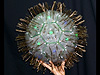
2003-2004
Trible
|
The "Trible" (Tactile Reactive Interface Based on
Linked Elements) is an excursive in dense distributed sensing,
computation, and actuation. It has the form factor of a ball,
tiled with a multimodal sensate "skin" consisting of 32
networked elements. Each tile measures pressure at 3 locations,
temperature, sound via a microphone, illumination, and dynamic
tactile stimulation with up to 12 channels of protruding,
touch-sensitive "whiskers". Each tile can also respond with a
small audio speaker, a pager vibrator, and a bright RGB LED.
There is no central processor - each tile talks to its
neighbors through conductors in the frame. The Trible is a
research platform for the application of decentralized control
and distributed estimation to human-computer
interaction.
|
Sensate Media
Perceptive Objects
|
|
|
Small bottlecap-sized computers, each with two
"thumbtack-like" rear-protruding pins, draw their power from a
layered composite into which they are pushed and communicate
with neighbors via infrared or capacitive coupling. Provisions
are made for simple sensors to be easily added to each pushpin,
enabling the system to serve as a testbed for developing
algorithms for extremely high-density, smart sensor
networks.
|
Sensate Media
|
|
|
A
compact, configurable wireless sensing system, for which
several sensing boards (e.g., tactile, inertial, sonar, etc.)
have been designed. These boards can be stacked in any order
and configuration atop a main processor/RF board, allowing the
sensor suite to be easily customized. A TDMA polling scheme
enables multiple stacks to be used simultaneously. Although it
has been primarily designed for wearable applications, this
device serves as a general platform for compact multimodal
sensing.
|
Sensor Architectures
Wireless Sensor Clusters
Wearable Systems
|
|
|
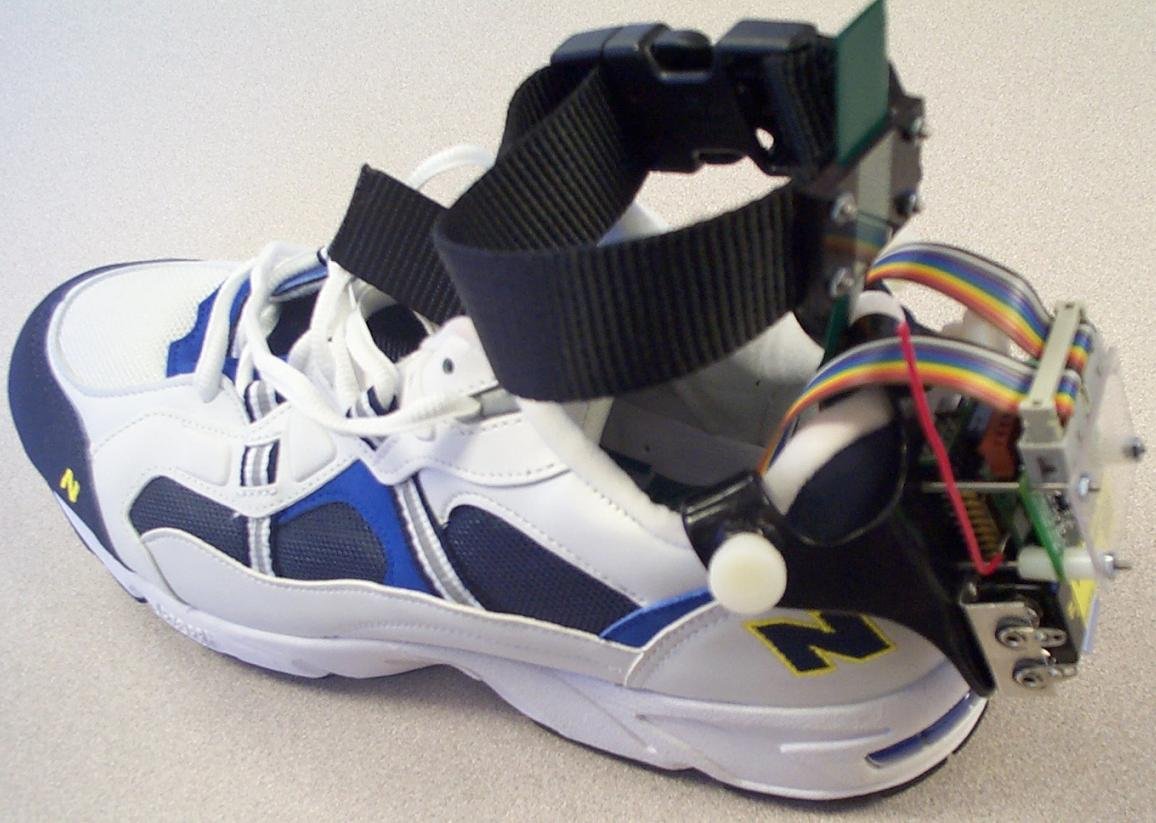
By measuring many (e.g., 20) different parameters at
each foot using our Sensor Stack, these shoes become a wearable
gait laboratory. Data is analyzed for features indicative of
particular gait problems. This system, in collaboration with
the MGH Biomotion Laboratory, is intended to diagnose gait
conditions and provide real-time corrective feedback to the
patient.
|
Embedded Healthcare
Wireless Sensor Cluster
|
|
|
An sensorcentric object model for distributed
systems.
|
Wireless Sensor Clusters
Sensate Media
|
|
|
This project explores microwave sensing for detecting
noncontact gesture. Several systems have been developed and
deployed, including very-low powered Doppler motion-sensing
radars with onboard digital feature extraction and modified
swept-Doppler ranging radars.
|
Sensor Architectures
Perceptive Spaces
|
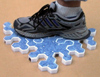
2000-2004
ZTiles
|
In
collaboration with the University of Limerick a sensate floor
is made from networked sensor tiles, each of which has over a
dozen small pressure sensors connected to an embedded computer.
All tiles are networked when they are snapped together. Local
communication between tiles establishes an ad-hoc network.
Sensor signals are compared across tiles, enable stimuli from
dynamic sources, such as footsteps, to be clustered and
abstracted into a basic set of parameters, which are routed
peer-peer across connected tiles to an external
computer. |
Sensate Media
Expressive Interfaces
Perceptive Spaces
|
|
|
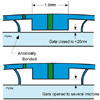
Precision capacitive sensing is used to determine the
dimension of an actively-controlled nanometer-scale gap. This
project, a collaboration with Alex Slocum's group in MIT's
Mechanical Engineering Department, has many applications in
biochemistry and nanoscale chemistry.
|
Sensor Architectures
|
|
|
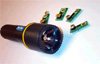
A
flashlight with an optically coded beam quasi-passively wakes
up active tags sleeping at extremely low power drain. If the
tag's ID matches the interrogating beam's request, a
tag-mounted LED flashes. The compact tags can be mounted on the
edge of removable media, for example, allowing a particular
item on a crowded shelf to be found by merely scanning the
flashlight across. The metaphor of seeking real-world objects
with a flashlight is thus extended into the realm of data.
|
Micro/Self Power
Perceptive Spaces
Wireless Sensor Clusters
|
|
|
Knocks and taps across a large sheet of glass are
detected by a set of pickup transducers, then characterized by
their frequency content and located via differential timing.
Essentially any single-paned window can be converted into the
equivalent of a touch screen by this inexpensive technique,
with no hardware mounted outside the glass.
|
Interactive Surfaces
Perceptive Spaces
Expressive Interfaces
|
|
|
An extremely low cost and
compact wireless motion sensor sends out a brief RF pulse when
jerked. As this device is very inexpensive, it can be given
away as a "ticket" to an event, allowing large audiences to
kinetically interact with responsive media. Feature extraction
algorithms and content mapping strategies to exploit the human
"schooling" and self-organizing reflexes with this system.
Although our research looks at interactive dance as an
application, other uses (e.g., interactive gesture and games at
sports events, conventions, and large concerts, very low-cost,
wireless shock monitoring of packages, etc.) abound.
|
Wireless Sensor Clusters
Expressive Interfaces
Micro/Self Power
|
|
|
A
Swept-RF magnetically coupled resonant tag reader has been
developed that exhibits enhanced stability, high resolution,
and the ability to address up to three reader coils. This
enables an ensemble of tagged objects to be wirelessly tracked
in 3 dimensions. This device has been used in a musical
environment that explores high-level gestural control of
musical structure (e.g., the definition, manipulation, and
overdubbing of musical sequences and arpeggiation) in live
performance.
|
Expressive Interfaces
Magnetic Tag Tracking
|
|
|
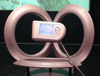
An interactive space has been designed that consists
of a carpet atop a mesh of piezoelectric wire (tracking foot
position and dynamic pressure) and a pair of Doppler microwave
motion sensors (to respond to movement of the arms and upper
body). This system has been used for several immersive musical
installations, and is now a permanent installation at the MIT
Museum.
|
Perceptive Spaces
Interactive Surfaces
Expressive Interfaces
|
|
|
This project has resulted in a batteryless pushbutton
that wirelessly transmits a 12-bit digital code to the vicinity
(e.g., 25-100 feet, depending on the RF environment) when
pressed. This enables digital controls, from light switches to
garage door openers, to be embedded essentially anywhere,
without worrying about battery life or wiring.
|
Micro/Self Power
Wireless Sensor Clusters
|
|
|
A
very low cost active magnetic tag tracker has been developed to
track the position and absolute orientation of a PDA around a
set of reader coils. Three such tracking stations have been
built and installed for the "Atmospheres" installation at the
MOMA "Workspheres" design exhibition.
|
Magnetic Tag Tracking
Expressive Interfaces
|
|
|
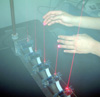
Free-gesture musical controllers suffer from the
drawback of having no tactile (and often no visual) reference
for their player, hence they are difficult to competently
master. This project has developed a hybrid musical controller,
consisting of a Theremin-like, free-gesture capacitive hand
sensor in the horizontal axis, punctuated by an array of
vertically-directed rangefinding lasers on mechanical carriages
that can be moved to preassigned positions. The lasers, in
light fog, are seen as references (or frets) - the position of
the hand is also detected along the laser beams, affording
another channel of expressive control. |
Expressive Interfaces
|
|
|
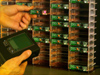
This
project draws on ideas from distributed, embedded, and parallel
computing in order to address the creation and management of
databases composed of large collections of physical objects
(e.g. mini DVs in a rack or books in a library). An IR
interrogation beamed at one object is transferred between
neighboring objects peer-peer, diffusing to all objects in the
environment (e.g., in the bookshelf). The sought-after item
then illuminates an indicator. |
Sensate Media
Perceptive Spaces
|
|
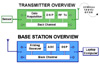
|
This
project is a design study for a TDMA basestation to be used
with very low power CMOS digital transmitters developed at
MIT's MTL for wireless sensor systems. |
Wireless Sensor Clusters
|
|
|
Several reader systems have been developed to
wirelessly track the position of magnetically-coupled resonant
tags. By making the tag's resonance frequency a function of a
local parameter (e.g., pressure or controller displacement),
the tag can also become a sensor. These systems have been used
to develop several demonstrations of "tangible bits" (where
simple objects become controllers), the most engaging of which
is a multimodal music environment called "Musical
Trinkets." |
Magnetic Tag Tracking
Expressive Interfaces
|
|
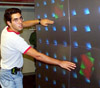
|
An
inexpensive scanning laser rangefinder has been developed to
track bare hands against a large interactive display. This
system provides a simple retrofit to any large surface - by
putting the rangefinder in one corner, a large virtual
"touchscreen" is created, with hand tracking insensitive to
background light. This system has been used in public with
several interactive applications ranging from information
browsers to musical interfaces. |
Interactive Surfaces
Expressive Interfaces
|
|
|
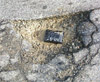
An
inexpensive, compact package has been developed to monitor
traffic (magnetically sensing passing cars) and detect local
road conditions (e.g., temperature and moisture). A summary is
wirelessly broadcast to a receiver mounted above the road
within circa 300 meters of the sensor package. As the specified
battery is projected to last for over a decade (depending on
conditions), a network of these low-cost packages can be
embedded into the roadbed, allowing the traffic report to be
generated right in the street. |
Wireless Sensor Clusters
Perceptive Spaces
|
|
|
A
simple scripting framework has been created to recognize
combinations of simple "atomic" gesture components in data from
body-mounted sensors. Much as the way in which phonemes combine
to form words, the user is able to specify a script of
sequential microgestures that form a desired macroscopic
gesture. When sensor data makes a good match with a specified
script, the gesture is detected. This algorithm is extremely
efficient and is able to run in real time on a low-end PDA, for
example. A pair of small, wireless, handheld, 6-axis inertial
measurement units (as shown here) were constructed to capture
gesture and test this framework. |
Wireless Sensor Clusters
Perceptive Objects
|
|
|
A
compact suite of medical instruments has been integrated into a
kit with a connected palmtop computer. Software has been
written to guide a medical assistant through the process of
running the needed tests on a patient, collecting the required
data, and transmitting it to a remote medical facility for
diagnosis. This system has been used with the LINCOS
installations to provide medical care in rural Costa
Rica. |
Embedded Healthcare
Wireless Sensor Clusters
|
|
|
Electricity is generated while walking by flexing and
pressing compact piezoelectric elements unobtrusively embedded
into a shoe sole. As a demonstration, a self-powered wireless
digital ID code is transmit directly from the shoe after every
few steps. |
Micro/Self Power
Wearable Systems
|
|
|
A
suite of 16 diverse sensor channels is embedded into each of a
pair of shoes. All parameters are wirelessly broadcast directly
from the shoes to a nearby basestation with 50 Hz full-state
updates. A very early example of compact multimodal wireless
sensing, this system has been designed and used for interactive
dance. With so many degrees of freedom measured, even a simple
musical rulebase enables a dancer to produce an engaging sonic
accompaniment. |
Wireless Sensor Clusters
Expressive Interfaces
Wearable Systems
|
|
|
A
wideband, dispersionless monopulse acoustic receiver can
theoretically be constructed with continuously-tapered,
co-located subapertures. Such a device would have the
capability of locating the direction of arrival of sonic
transients by calculating a simple sum and ratio. This project
has built and characterized such a device. |
Sensor Architectures
|
|
|
A
large mylar balloon has been bonded to a piezoelectric foil
sheet so it can act as both a microphone and a loudspeaker. A
set of electronics has been designed for the balloon to detect
significant audio activity, and play a selection from a set of
prerecorded audio samples when the activity ceases,essentially
enabling one to have a "dialog" with the balloon. Over 50 such
balloon systems were produced and installed all over the
Weisner Building for the Media Lab's 10'th anniversary
celebration. |
Perceptive Objects
Sensor Architectures
|
|
|
An
16-element array of 4 x 4 programmable electrodes was built in
order to study electric field imaging in air. Each electrode
could dynamically be assigned to either transmit or receive.
|
Sensor Architectures
|
|
|
Many
different musical controllers (ranging from digital batons to
sensor chairs) were designed and constructed for the "Brain
Opera", a very large interactive musical installation that was
produced at the MIT Media Lab and toured throughout the
world. |
Expressive Interfaces
|